4. Sovereign Ethereum Equivalence and Architecture
MIZUHIKI's architecture reflects a single choice: to take Ethereum's continuing technical progress as the baseline, and to deploy it on infrastructure whose operators, server locations, and legal accountabilities are all on Japanese soil. This section sets out what that choice means in practice, why it was made in preference to forking Ethereum or building from first principles, and how the resulting system is organised.
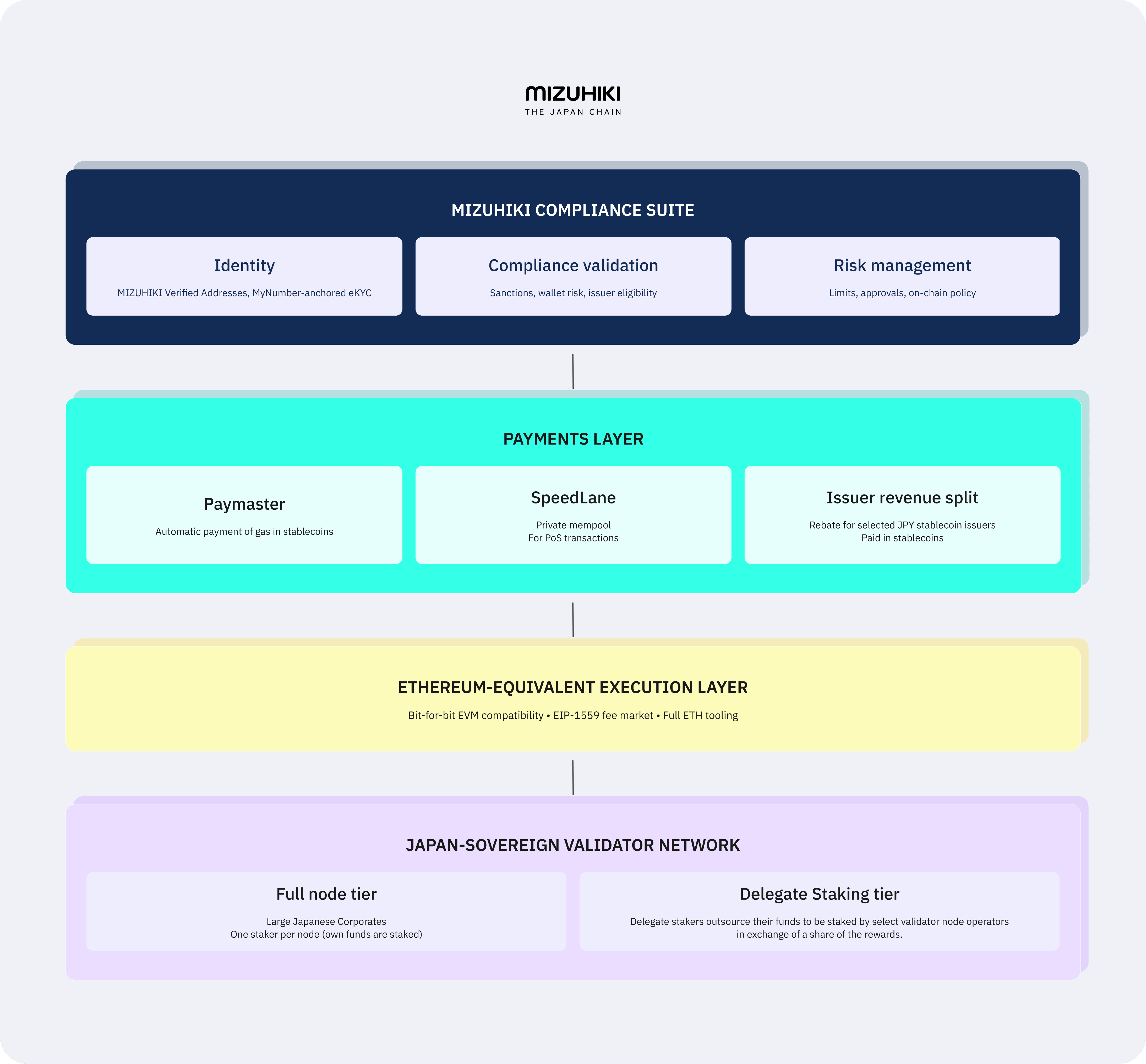
4.1 Sovereign Ethereum Equivalence
MIZUHIKI is built on the principle of Sovereign Ethereum Equivalence: a deployment of the Ethereum protocol that keeps pace with future security, scaling, and technology innovations of Ethereum mainnet, but on validator client infrastructure that is all known, named, and located onshore in Japan.
The analogy MIZUHIKI offers is to the spectrum of computational service offerings in enterprise computing, ranging from shared cloud services at one end, through co-located dedicated resources, to fully on-premises infrastructure for the most sensitive use cases at the other. MIZUHIKI is a public, permissioned blockchain — anyone may read its state, deploy contracts on it, or transact on it — but its validation is permissioned and specifically "on-premises" in Japan.
Ethereum Equivalence maintains bit-for-bit compatibility at the execution layer: every opcode, every call, every transaction that would execute on Ethereum mainnet executes identically on MIZUHIKI. Developers can deploy existing smart contracts, use existing tooling (Foundry, Hardhat, MetaMask, ethers.js, viem), and rely on existing standards (ERC-20, ERC-721, ERC-4337) without modification.
What differs is not the execution environment but the validator set beneath it.
4.2 Network Architecture
MIZUHIKI's architecture comprises three main components, each of which is described more fully in the sections that follow:
-
The Blockchain layer, consisting of selected Validator Client Operators located onshore in Japan, running a Proof of Stake consensus protocol (Section 9).
-
The Compliance Suite, a set of modular, opt-in protocols providing identity verification, regulatory validation, and internal risk management for applications that require them (Section 6).
-
The Payments Layer (feat MIZUHIKI SpeedLane and Paymaster), a custom-built execution layer designed for fast, in-store PoS payments for stablecoins. Private payments are also considered a priority, opt-in feature of the payments layer, in particular for corporate payments. SpeedLane provides private endpoints for certain transaction types that allow retail stores to achieve deterministic finality in under one second. All MIZUHIKI block builders prioritise transactions in the private SpeedLane mempools, allowing settlement guarantees ahead of the six second block time.
Each of these layers is designed to be composable with the others, so that application developers can build against MIZUHIKI at whichever level of abstraction serves their needs.
4.3 Consensus and Finality
MIZUHIKI operates a Proof of Stake consensus protocol, validated by a permissioned set of Validator Client Operators located in Japan. With a smaller and more geographically colocated validator set than Ethereum Mainnet, MIZUHIKI will start with a block time of six seconds (half of Ethereum Mainnet), while actively looking to safely reduce finality times alongside Ethereum protocol upgrades focussed on improving block time and finality speeds1.
For retail payments, the SpeedLane layer targets deterministic sub-second finality for stablecoin transactions. Retail payment use cases including point-of-sale acceptance, require confirmation times indistinguishable from those of card or payment apps. Each permissioned node operator will run a customised block builder that prioritises transactions submitted to the private SpeedLane mempool(s). This customisation is only achievable since the MIZUHIKI validator set is completely permissioned; permissionless blockchains are not able to offer sub-second deterministic finality to a subset of transactions in the same way.
MIZUHIKI SpeedLane is designed to offer payments participants the same confirmation experience they expect from existing payment infrastructure, while preserving the settlement properties of a public blockchain.
Every MIZUHIKI validator node is operated onshore in Japan, by a Japanese legal entity, on hardware meeting published security and availability standards. The Foundation specifies a minimum specification for validator infrastructure — including processor, memory, storage, network, and physical security requirements — and a minimum operational specification — including uptime commitments, incident response, key management, and disclosure obligations. Validator operators agree to Foundation-published governance terms as a condition of operating a node.